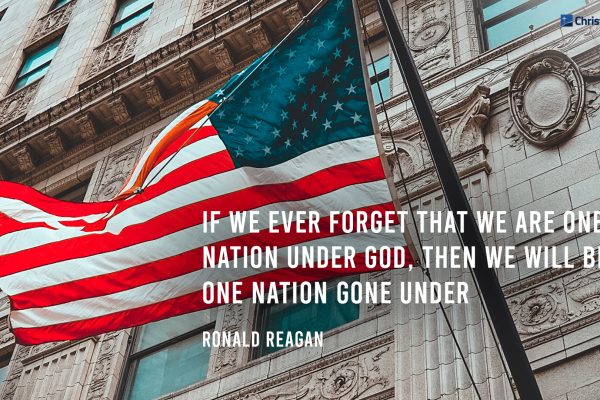
abstract: Whenever a state moves from defense to offense, from keeping the peace within its borders to extending justice to all, including people living beyond its borders, who have never covenanted before God and man to be under its authority, we see another incarnation of the messianic state.
National Reform Association ==>Christian Statesman ==>January - February 2004 ==>Incarnations of the Messianic State
"Who or what is the savior of mankind?" This is one of the most fundamental questions in the history of man. Religions clash and civilizations clash, sometimes literally, over competing answers to this question.
The Bible has one answer: God. God is the redeemer of men: the One who buys mankind back from conditions of servitude and death. Specifically, the New Testament teaches that Jesus Christ, as the only God-man, in His atoning act on Calvary, provided the judicial basis of a person's claim on heaven. He, and He alone, is the sole link between heaven and earth, eternity and history. All branches of the church accept this teaching, however modified.
Ever since the rise of the great empires a millennium before the birth of Jesus, there has been another answer: "The state is the agent of salvation." Men are told that only through participation in the transforming power of the state can they find spiritual healing in time and eternity. The state is said to be the link between heaven and earth, time and eternity.
There is a conflict of visions here. The great debate is over the identity of the messiah: the agent of salvation, meaning healing. (Salve = a healing ointment.) For this reason, the church historically has been at war with the messianic state.
But there have been times--we live in such a time--in which messianic states have confused the faithful in the pews, successfully inviting their support of policies that can best be described as messianic. Politicians have recruited supporters in the churches for policies based on a theory of salvation by law, but in a specific form: salvation by legislation. The state is regarded as a healer: not only the provider of good things, but more than this, an agency that can make men good.
The state's claims always extend to the education of the young. R. J. Rushdoony's book, The Messianic Character of American Education (1963), is a well-documented introduction to the theology of statist salvation through tax-funded education. It is a detailed history of the writings of two dozen pioneers in America's statist system of education. But the same messianic impulse extends to every aspect of life. The messianic state does not accept limits on its claims, for all of life must be transformed by its healing power. There is no King's X from a state with messianic pretensions. Defenders of the messianic state honor no claims of immunity from the state's assertion of its comprehensive ability to heal, and therefore its mandate to heal.
The Roman Empire engaged in an intermittent war against Christianity for almost three centuries because Christians refused to accept the emperors' escalating claims to divinity. They denied that the emperors represented the link between time and eternity. Theologian and numismatist Ethelbert Stauffer a generation ago wrote a book on this war, as reflected in the coinage of the Empire. As the coins' content of precious metals declined over the decades, the inscriptions of the emperors, whose images were on these coins, became more messianic. (Stauffer, Christ and the Caesars [1955].)
That war is still going on. Whenever a state moves from defense to offense, from keeping the peace within its borders to extending justice to all, including people living beyond its borders, who have never covenanted before God and man to be under its authority, we see another incarnation of the messianic state.
In the Book of Daniel, we read of Daniel's interpretation of King Nebuchadnezzar's dream about a great image. The dream had to do with the rise and fall of earthly kingdoms. Daniel offered a prophecy in the form of an interpretation. This prophecy has shaped Christianity's view of history ever since the post-Apostolic era. First, Daniel told the king what his dream was, for the king had stipulated that the interpreter must not only interpret the dream but also summarize it. This, Daniel did.
This image's head was of fine gold, his breast and his arms of silver, his belly and his thighs of brass, His legs of iron, his feet part of iron and part of clay. Thou sawest till that a stone was cut out without hands, which smote the image upon his feet that were of iron and clay, and brake them to pieces. Then was the iron, the clay, the brass, the silver, and the gold, broken to pieces together, and became like the chaff of the summer threshingfloors; and the wind carried them away, that no place was found for them: and the stone that smote the image became a great mountain, and filled the whole earth (Daniel 2:32-35).
This description of metals of diminishing value can be found in Hesiod's Works and Days, which had been written centuries earlier. The ancient world saw this depreciation as describing inevitable historical decline: from the age of gold to the age of iron. But Daniel's interpretation offered hope: an escape from impermanent earthly kingdoms.
And in the days of these kings shall the God of heaven set up a kingdom, which shall never be destroyed: and the kingdom shall not be left to other people, but it shall break in pieces and consume all these kingdoms, and it shall stand for ever. Forasmuch as thou sawest that the stone was cut out of the mountain without hands, and that it brake in pieces the iron, the brass, the clay, the silver, and the gold; the great God hath made known to the king what shall come to pass hereafter: and the dream is certain, and the interpretation thereof sure (Daniel 2:44-45).
This prophecy of a future kingdom of God has served as a warning against the pretensions of empire. But the lure of empire is strong. When a society adopts a theory of salvation by law, some people within its ranks seek to become law-givers and, more to the point, law enforcers. They seek this power through the agency of the state.
The crucial question, "Who shall heal?" eventually becomes "Who shall heel?" C. S. Lewis described it well in his little book, The Abolition of Man (1947).
For the power of Man to make himself what he pleases means, as we have seen, the power of some men to make other men as they please. In all ages, no doubt, nurture and instruction, in some sense, attempted to exercise this power.... But the man-moulders of the new age will be armed with the powers of an omnicompetent state and an irresistible scientific technique: we shall get at last a race of conditioners who really can cut out all posterity in what shape they please.
Lewis used this theme to produce a great novel, That Hideous Strength (1945), which he subtitled, A Modern Fairy-Tale for Grown-Ups. Into the mouth of one of the most cunning of the characters in the book, Lord Feverstone, he put these words:
Man has got to take charge of Man. That means, remember, that some men have got to take charge of the rest--which is another reason for cashing in on it as soon as one can. You and I want to be the people who do the taking charge, not the ones who are taken charge of. Quite.
Feverstone added this: "If you try to be neutral you become simply a pawn."
In the novel, Lewis identified the agency of change and national healing: a research organization called the National Institute of Co-ordinated Experiments. The acronym expressed the organization's deliberate positioning: N.I.C.E.
The Pledge of Allegiance, written in 1892 by a socialist minister for use in the tax-funded primary schools, ends with these words: "with liberty and justice for all." At least the Pledge is limited to one flag. It is also limited to people who voluntarily pledge their allegiance.
The problem for American foreign policy escalated in 1898, when America's victory in Mr. Hearst's Spanish-American War delivered Puerto Rico and the Philippines into the hands of the U.S. government. To whom or what would the citizens of those nations now pledge allegiance? What sanctions would be applied, both positive and negative, to gain their pledge of allegiance?
World War I was fought, according to Mr. Wilson, to make the world safe for democracy. It was heralded as the war to end all wars. The escalating messianic character of American foreign policy by 1918 had manifested itself for all the world to see. It could also be funded: by the Federal income tax and the Federal Reserve System.
War by war, Americans have been dragged into foreign bloodbaths, each time in the name of some overarching purpose, each war justified in the name of extending the American way of life.
America for well over a century has been engaged in the course of empire. Americans do not like to think of this long-term venture as empire. They want to think of it as bringing healing to victims. But this is the heart of empire, and has been since the days of Assyria. If booty were the only goal, then mere tribute would suffice. But booty is not the primary goal. Booty is a means to the goal: the self-funding of the losers' participation in the healing power of the messianic state.
The Marshall Plan substituted American taxpayers' funding of American corporations and farm conglomerates by way of purchases by European governmental agencies. It was state-to-state aid, as "foreign aid" always is, and from there to big American corporations. This system of funding made clear the fact that the overriding foreign policy issue is the extension of America's civic theology of salvation by law, not the collection of tribute. But, in the extension of salvation by law, there must be winners and losers. Corporate America is a winner. The taxpayers and the conquered foreign populations are victims.
When you think of "liberty and justice for all," think "Bureau of Indian Affairs," for it was this agency, more than any other, that launched America's dual experiment: the welfare state and empire. The two went hand in hand, or more accurately, fist in fist. Rushdoony, a Presbyterian missionary to the Western Shoshone tribe in Idaho and Nevada in the 1940's and early 1950's, wrote of the destructive power of the welfare state in the lives of Indians (Life on the Reservation, Foundation for Economic Education, Clipping of Note, #27).
Over a century after the reservation system was imposed on native Americans, the poverty level is greater on those reservations than anywhere else in American society. The failure of the experiment has been almost total. Its defenders prefer not to speak of it. The tribes were conquered "for their own good." The American taxpayer has funded the "beneficiaries" from the beginning. This has not been done in quest of tribute. It has been done in quest for salvation by law.
Why do American taxpayers stomach the twin experiments of the welfare state and empire, generation after generation? I answer: out of their deep-felt commitment to the theology of the messianic state. They do so for the dream of participating in a messianic venture, which is a much-preferred substitute for the only one that offers legitimate hope: salvation by God's grace. Americans want to believe that salvation by grace may be suitable for individuals, but salvation by law is for chosen nations--self-chosen nations, nations with a manifest destiny. The primary manifestation of this destiny is victory on military battlefields. Might does not make right, Americans insist, but they deeply believe that might demonstrates right.
Americans have misread their Bibles when they have read them at all. They have not understood messianic foreign policy, from the Babylonian King's dream to Operation Iraqi Freedom. This message is clear: men are forever tempted to bet their lives, their honor, and their money on the success of the latest incarnation of the messianic state. They always lose this bet.
But a few Americans are self-consciously committed to the corollary of the messianic state: "Man has got to take charge of Man. That means, remember, that some men have got to take charge of the rest--which is another reason for cashing in on it as soon as one can."
I would therefore remind you: "If you try to be neutral you become simply a pawn."
Gary North is the author of hundreds of articles and essays and over three dozen books on economics, the Bible, social theory, education, and history. His work is available at www.freebooks.com.
Publishers of
The Christian Statesman.
Declaring the Lordship of Christ since 1864
editor
Bill Einwechter
A six month subscription to The Christian Statesman
is FREE on request. Renewals are FREE on request.
POBox 8741-WP
Pittsburgh, Pennsylvania 15221
Use this form to comment on this site. Use this form to request a FREE introductory six month subscription to The Christian Statesman or to renew your existing subscription.
For a FREE introductory three issue subscription,
send email to
Bill Gould with
your
name and mailing address.